Editorial & Sourcing Note
This analysis draws from the original broadcast of Shark Tank Australia (Network Ten, Season 2, Episode 3, May 2016), publicly accessible Australian Securities and Investments Commission (ASIC) company records, the Australian Business Register (ABR), IP Australia patent and trademark databases, and the Union Cycliste Internationale (UCI) Technical Regulations in force during the 2016 competitive season. Registry searches were conducted in November 2026. This piece covers the Australian version of Shark Tank, not the US ABC franchise. The two shows share a format but feature entirely separate investor panels, production companies, and deal histories. Last updated: November 2026.
The Projection With an Expiry Date
In May 2016, a mechanical engineer named Richard Ploszaj walked onto the set of Shark Tank Australia and told five investors his bicycle company would be worth $5 billion within four years.
It’s now well past 2020. The $5 billion never materialised. The company’s business registration was cancelled in early 2019. And the bicycle itself—a pump-action contraption that replaced traditional round pedalling with a vertical stomping motion—never made it to a single professional race, let alone the Tour de France.
Ploszaj invested real engineering hours into his prototype, and pitching on national television takes conviction. Yet the Troppo Bicycle appearance on Shark Tank Australia remains one of the clearest case studies in why venture investors reject unvalidated financial projections. For the other side of the coin, see our breakdown of Shark Tank products that failed after the show despite getting funded. The gap between what was claimed on camera and what the numbers actually showed was enormous, and the Sharks saw it immediately.
Here’s what happened during the pitch, why every single investor walked away, and what a search through Australian corporate and intellectual property registries reveals about the brand today.
At a Glance: The Troppo Bicycle Pitch
| Detail | Summary |
|---|---|
| Entrepreneur | Richard Ploszaj (Mechanical Engineer, Queensland, Australia) |
| Show & Air Date | Shark Tank Australia, Season 2, Episode 3 (Network Ten, May 2016) |
| The Ask | $5,000,000 AUD for 49% equity |
| Implied Valuation | ~$10.2 Million AUD |
| Projected Valuation | $5 Billion AUD by 2020 |
| Units Sold Pre-Pitch | 20 bicycles |
| Retail Price per Unit | $2,600 AUD |
| Manufacturing Cost per Unit | $2,600 AUD |
| Gross Margin | 0% |
| Deal Outcome | No deal — all five Sharks declined |
| November 2026 Registry Status | ABN cancelled 25 Feb 2019; no active Pty Ltd company found |
What Was the Troppo Bicycle?
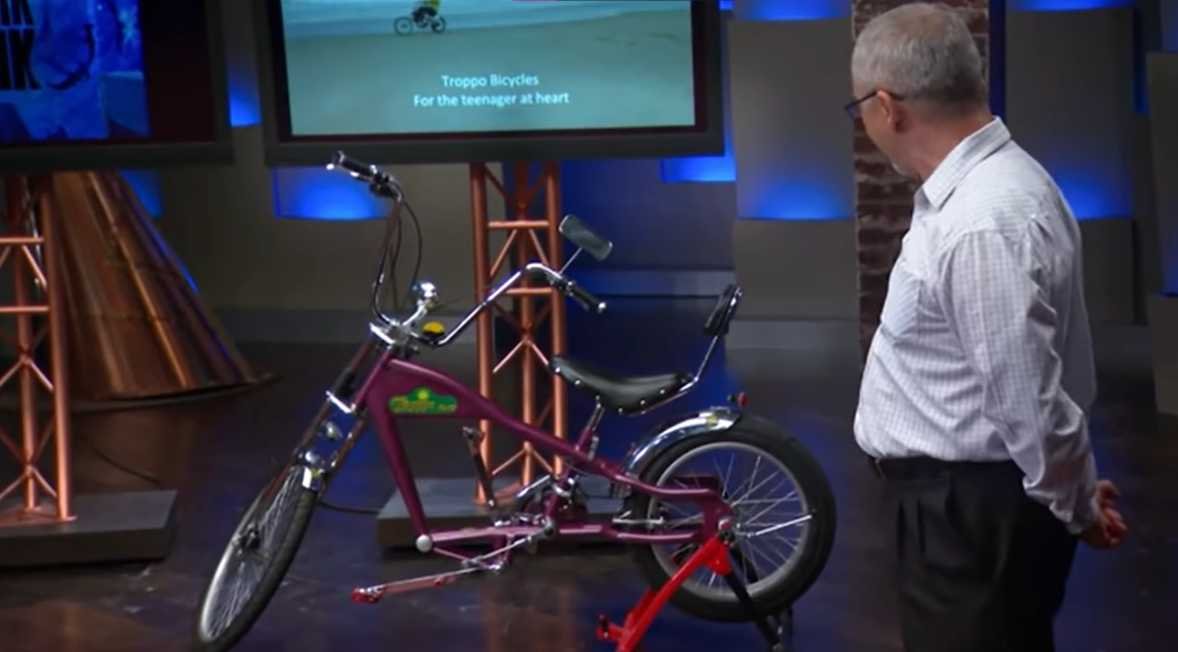
The core idea was simple to describe and radical in execution: replace the 360-degree rotary crankset that every modern bicycle uses with a linear, pump-action pedal system.

Instead of pushing your feet in circles, you’d stomp them up and down in a vertical reciprocating motion—closer to a stair-climber machine than a conventional bike. Ploszaj argued that this linear drive was more biomechanically efficient because it eliminated the “dead spots” in a traditional pedal stroke, the top and bottom of the rotation where your legs generate minimal torque.
On camera, Ploszaj claimed that bicycle propulsion hadn’t fundamentally changed in roughly 200 years and that his design represented the first genuine leap forward. He described the mechanism as “100% efficient” and suggested it had received some form of technical “approval,” though he never specified by whom.
A standard bicycle chain already operates at 95–98% mechanical efficiency; adding reciprocating linkages to convert vertical stomps into wheel rotation introduces extra friction, making “100% efficiency” physically impossible.
Inside the Pitch: $5 Million for 49% Equity
Ploszaj wanted $5 million AUD for 49% of his company, implying a total business valuation of roughly $10.2 million. For a business that had sold 20 hand-built bicycles out of a garage at zero profit, that valuation required a leap of faith no investor on the panel was willing to make.
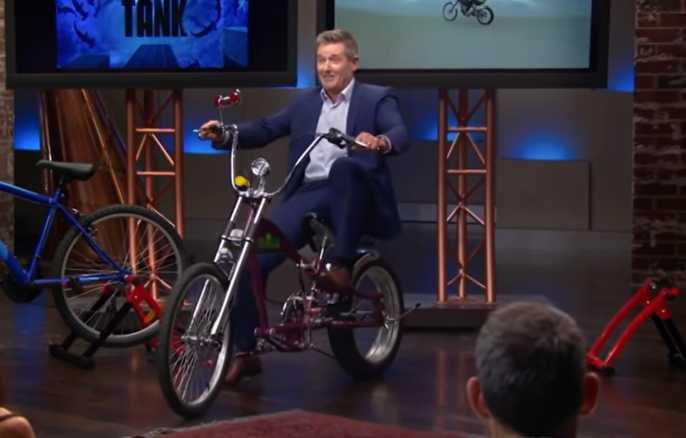
Ploszaj also projected that Troppo Bicycle would reach $5 billion by 2020—four years from the pitch date. His go-to-market strategy hinged almost entirely on professional cycling: get the Troppo Bicycle into the hands of elite riders, win the Tour de France, and let that victory trigger global consumer demand.
The plan had a fatal flaw: it was legally impossible under the rules governing professional cycling.
The Union Cycliste Internationale (UCI), the sport’s global governing body, maintains strict technical regulations for all sanctioned events, including Grand Tours. Under the UCI Technical Regulations in force during the 2016 season (Part 1, Chapter 3, Article 1.3.016), a competition bicycle must be propelled solely by a chain acting on a traditional crankset-and-chainwheel drivetrain. Reciprocating pump mechanisms and alternative propulsion systems are explicitly excluded. (UCI article numbering shifts between annual editions; consult the current regulations PDF for the latest reference.)
Ploszaj’s entire marketing strategy was built on a foundation the sport’s governing body would not permit. The Troppo Bicycle could never legally compete in the race he was counting on for global exposure. The Sharks didn’t all cite this specific regulation on air, but the broader point landed clearly: the go-to-market plan depended on a scenario that couldn’t happen under existing rules.
The Unit Economics: 20 Bikes Sold at Zero Margin
The numbers were the most damning part of the pitch.
During questioning, the Sharks uncovered that Ploszaj had sold approximately 20 Troppo Bicycles prior to appearing on the show. Each bike retailed for $2,600 AUD. The manufacturing cost per bike was also $2,600 AUD.
The cost to build each bicycle was identical to the price customers paid. That’s a gross margin of zero percent—before accounting for shipping, customer service, warranty claims, marketing, or the value of Ploszaj’s own labour.
There was no manufacturing facility, no supply chain contracts, and no quality control process beyond Ploszaj’s hands in his garage. Each bicycle was a custom build, which works for prototyping but is catastrophic for scaling. You cannot inject $5 million into a business with zero gross margin and expect growth. Compare this with The Sleep Styler’s unit economics, where a $39 retail price against sub-$10 production costs made scaling possible. At zero margin, additional capital just burns through production costs without generating a single dollar of profit to reinvest.
A business that breaks even on every unit sold doesn’t become profitable by selling more units. It just burns cash faster.
Why the Sharks Called the Funding Structure “Fraud”
Beyond the product and the numbers, the pitch collapsed on the funding mechanism itself.
Ploszaj’s plan for the $5 million was unconventional. Rather than spending the investment on manufacturing, hiring, or distribution, he proposed parking the Sharks’ capital in a bank account as static collateral. The idea was that $5 million in private investment would unlock dollar-for-dollar matching grants from Australian government co-investment programs, effectively doubling the available capital without the Sharks’ money ever being “at risk.”
The panel’s reaction was swift. Steve Baxter, the tech entrepreneur and former venture capitalist on the Australian panel, pushed back hard on the legality and logic of the structure. Government co-investment and matching grant programs in Australia require that private capital be actively deployed into qualifying business activities—R&D, manufacturing, commercialisation. The funds must be genuinely at risk in operational expenditure. Parking investment capital in a term deposit to artificially inflate a grant application misrepresents the nature of the investment to the granting body.
The word “fraud” was used on air to describe this proposed structure (watch the exchange here). Whether Ploszaj intended to mislead anyone is a separate question—he may have genuinely misunderstood how co-investment grants function. But the mechanics of the proposal, as described on camera, would not have passed scrutiny from any government grants administrator, and the Sharks knew it.
What Happened to Troppo Bicycle After Shark Tank? (November 2026 Registry Audit)
Most online coverage of the Troppo Bicycle stops at the pitch recap. I went looking through the public records to find out what actually happened next.
Australian Business Register (ABR).
A search of the ABR shows ABN 73 474 118 678 registered to Richard Ploszaj as an individual sole trader based in Queensland (postcode 4178). The ABN was cancelled on 25 February 2019—nearly three years after the Shark Tank broadcast. The business was never incorporated as a proprietary limited (Pty Ltd) company, which aligns with what the Sharks uncovered during the pitch: Ploszaj was operating without formal corporate infrastructure.
ASIC Company Registry.
No active proprietary limited (Pty Ltd) company matching the Troppo Bicycle brand appears in current ASIC records. No company was ever incorporated to commercialise the product at scale.
IP Australia Patent and Trademark Search.
Ploszaj claimed on air that his invention had been “approved,” which could reasonably be interpreted as a reference to patent protection. A search of IP Australia’s AusPat and ATMOSS databases for patents or trademarks filed under Richard Ploszaj’s name in relation to bicycle propulsion mechanisms returned no active, granted patents covering the Troppo pump-action drivetrain as of November 2026. This doesn’t necessarily mean no application was ever filed—provisional applications can lapse without entering the public record in the same way—but there is no enforceable intellectual property protection currently in force.
Digital Footprint. There is no active commercial website for Troppo Bicycle. No e-commerce store, no social media presence, and no retail distribution partnerships. A search of the Internet Archive’s Wayback Machine turned up no archived commercial storefront or active product domain under the Troppo Bicycle brand.
Richard Ploszaj’s Current Status.
Public registries do not show his current employment, and the absence of a corporate trail confirms only that Troppo Bicycle never reached commercial production.
Lessons for Founders: Why Projections Without Infrastructure Fail
Three specific mistakes from the Troppo pitch are worth extracting.
1. Fix your unit economics before you ask for capital
A $5 million investment cannot fix a zero-percent gross margin. If it costs you $2,600 to build a product you sell for $2,600, scaling up just means you burn through cash faster. Investors want to see that each additional unit sold generates profit that compounds. Bombas is the counterexample: healthy margins on a consumable product that compounded into $2 billion in lifetime sales.
2. Verify regulatory constraints before building your go-to-market strategy around them
Ploszaj’s entire growth plan depended on the Tour de France, but UCI regulations explicitly prohibit non-traditional drivetrains in sanctioned competition. A single afternoon reading the technical rulebook would have revealed this roadblock. If your marketing strategy requires a regulatory exemption you don’t have, you don’t have a strategy—you have a wish.
3. Investors fund execution and traction, not theoretical future valuations
A $5 billion projection means nothing without the corporate structure, manufacturing partnerships, supply chain agreements, and revenue trajectory to support it. The Sharks on Shark Tank Australia see hundreds of pitches. The ones that get funded are the ones where the founder can demonstrate that the next $100,000 will produce measurable results—not the ones where the next $5 million might theoretically unlock a government grant that might theoretically fund a factory that might theoretically produce a bike that might theoretically win a race it’s not legally allowed to enter.
Frequently Asked Questions
Did Troppo Bicycle get a deal on Shark Tank?
No. All five Sharks on Shark Tank Australia declined to invest during the Season 2, Episode 3 pitch in May 2016. The rejection was driven by zero gross margins on the 20 units sold, the absence of formal corporate or manufacturing infrastructure, and serious concerns about the legality of the proposed government co-investment funding structure.
What happened to Richard Ploszaj after Shark Tank?
Based on searches of the Australian Business Register, ASIC company records, and IP Australia patent databases conducted in November 2026, Richard Ploszaj’s sole trader ABN was cancelled on 25 February 2019. No Pty Ltd company was ever incorporated, no patents were granted, and no commercial manufacturing appears to have taken place after the broadcast.
How much did a Troppo Bicycle cost?
The Troppo Bicycle retailed for $2,600 AUD per unit, which was identical to Richard Ploszaj’s stated manufacturing cost. This left a gross profit of $0 on each of the 20 bicycles sold prior to the Shark Tank appearance.
Was Troppo Bicycle on US Shark Tank or Shark Tank Australia?
The Troppo Bicycle pitch aired on Shark Tank Australia (Network Ten, Season 2, Episode 3, May 2016), not the US ABC version. The Australian panel featured investors Steve Baxter, Janine Allis, Andrew Banks, Naomi Simson, and Glen Richards—entirely separate from the American Sharks.