


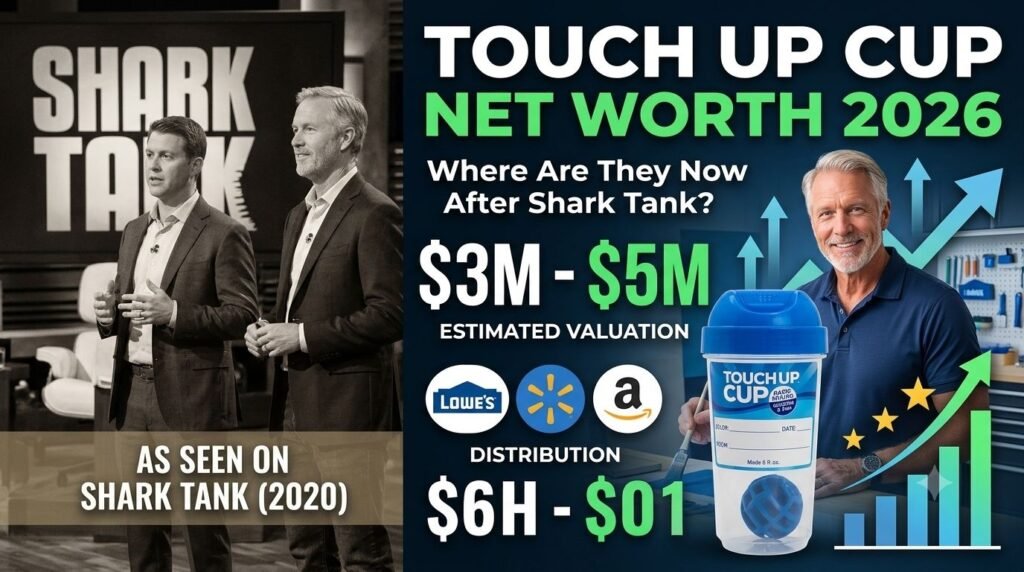
Anyone who has painted a room knows the leftover can. It sits in the garage for two years, the rim crusts over, and by the time you need to fix a scuff on the hallway wall the paint inside has gone lumpy or grown a skin. Carson Grill got tired of that while helping his dad touch up walls at home, and the fix he came up with ended up on Shark Tank in October 2020.
Touch Up Cup is still around, which is more than you can say for plenty of Shark Tank products. Based on the sales figures the Grills and the show have shared, Touch Up Cup in 2026 is probably worth somewhere in the low single-digit millions — roughly $3 million to $5 million — but nobody outside the company can give a precise number. This post covers what the product does, how the pitch went (the deal was not what the Grills asked for), what sales looked like afterward, and a realistic read on what the company is worth. That last part comes with a warning: it’s a private company, and nobody has published audited numbers.
What Touch Up Cup actually is
It’s a 13-ounce plastic cup with a screw lid and an airtight silicone seal. You pour in the leftover paint from a job, close it, and write the color, date and room on the label. Carson told the Sharks the paint stays fresh for more than 10 years. Inside there’s a mixing piece that breaks up clumps when you shake the cup, so you don’t need a stir stick or a paint tray. You dip the brush straight in.
The problem is a real one. Carson and his father Jason, who are from the Cincinnati area in Ohio, went to touch up the walls one day and found the old paint cans rusted and the paint inside clumped and smelling off. Carson decided there had to be a better way and designed the cup himself. It’s patented, and he also holds three design patents on containers for muffins, bagels and donuts.
A couple of things changed after the show. The cup in the pitch had a red lid and a stainless steel mixing spring. The one on shelves now is blue with a plastic spiral. The company hasn’t said why, but lower cost and shipping weight are the obvious guesses.
The Shark Tank pitch
Touch Up Cup aired on October 16, 2020, in the Season 12 premiere. Carson was 15 and had just started his freshman year at Bishop Fenwick High School. He ran the pitch and answered nearly every question, which caught the Sharks off guard. Kevin O’Leary pointed out that when a dad brings his son on, the dad usually does the talking. Jason’s reply was that they run the business 50/50.
The ask was $150,000 for 10%, a $1.5 million valuation. Carson’s numbers: about $220,000 in sales over the previous two years, on pace for roughly $400,000 in 2020, split about 70% online and 30% retail, in around 4,000 stores. A cup cost 90 cents to make and sold for $3.99 to $4.99. Daymond John’s reaction was “I love this kid.”
Then the offers came in:
| Shark | Offer | What happened |
|---|---|---|
| Blake Mycoskie (guest, founder of TOMS) | $200,000 for 25% | Wouldn’t move off it; Carson accepted |
| Daymond John | $200,000 for 17.5%, later revised to $150,000 for 20% | Revised his offer after realizing neither Grill could run the company full-time; kept it on the table, but the Grills chose Mycoskie |
| Kevin O’Leary | No offer | Suggested Carson drop out of school to run it; Carson said he’d just finished 8th grade and that wasn’t happening |
| Mark Cuban, Lori Greiner | No offer | Out |
Look at the math on the winning offer. Mycoskie put in $50,000 more than the Grills asked for, but took 25% instead of 10%. That values the company at $800,000 after the deal, lower than the $1.5 million they walked in with. He pushed the extra cash on purpose, and said he’d fund purchase orders, so they could buy inventory and get on more shelves. The deal closed, and Mycoskie later tweeted that he’d felt an instant connection to Carson and Jason.
You’ll see other deal terms online, including $150,000 for 17.5%. The recap CNBC published at the time has Mycoskie at $200,000 for 25%, and that’s the figure used here.
What happened after the episode
By the Sunday after the broadcast, Jason said thousands of orders had come in through the website from around the world. The follow-up segment on the show put sales on the night of the episode at about $50,000. Carson said he’d started high school, grown a foot and turned Touch Up Cup into a million-dollar company.
Retail did most of the work from there. The update mentioned a deal covering about 3,000 Walmart stores and another for 1,700 Lowe’s stores, which the show said put them on track for more than $3 million in 2022. Today the cups are sold on touchupcup.com, on Amazon and at Lowe’s. There’s also a private-label arrangement with Frog Tape, the painter’s tape brand.
The line has grown past the cup too. The Touch Up Tarp, a no-slip drop cloth, launched in January 2023. The company’s site now sells brush and roller preservers and paint brushes next to the cups and the muffin, bagel and donut containers. The most common complaint from customers is that the cup is too small when there’s more than a cupful of paint left over.
Touch Up Cup net worth and revenue
Nobody outside the company knows the exact number. Touch Up Cup is private and the Grills haven’t published financials, so anything claiming precision is guessing. Here is what has actually been said in public:
| Period | Sales | Where it comes from |
|---|---|---|
| Two years before the pitch | About $220,000 combined | Carson, on the show |
| 2020 | On pace for about $400,000 | Carson, on the show |
| Year before the follow-up segment | About $1 million | Shark Tank update segment |
| 2021 | $2 million | Jason Grill, quoted by Shark Tank Talks from the Cincinnati Business Courier |
| 2022 | Over $3 million (projection) | Shark Tank update segment |
| 2024 | About $5 million | An estimate from an academic paper (via Hunker) consistent with the Shark Tank Blog’s 2024 update. Still not audited. |
The $1 million and $2 million figures overlap awkwardly, probably because they measure different 12-month stretches, so treat both as rough. Jason has said he’d like to reach $5 million in sales by the time Carson starts college.
Valuation
The only hard valuation is the one from the show: $800,000 after Mycoskie’s investment, set in 2020 when sales were around $400,000 a year. Pages quoting net worth since then range from about $2 million to $3 million. A few quote far bigger numbers, like $150 million. Those pages are describing a makeup product or coffee pods that share the name, not the paint cup. Ignore them.
My own estimate, and it is an estimate, is a company value somewhere between $3 million and $5 million. That fits revenue in the low millions and is consistent with independent reporting from Hunker and Shark Tank Blog. That range basically assumes a valuation of around 0.6x–1x 2024 revenue, which is a normal ballpark for a small but profitable, unsexy physical product brand doing a few million dollars a year in hardware. At that range, Mycoskie’s 25% stake would be worth about $750,000 to $1.25 million. Neither Carson nor Jason has said what they’ve taken out of the business, so there’s no honest personal net worth to report for them.
Margins
The economics are the reason the numbers work at all. According to a summary of the pitch, a single cup costs $0.90 to make, wholesales for $1.89 and retails for $3.99 to $4.99. That’s a gross margin of about 52% at wholesale, before shipping and marketing. The three-pack costs $1.99, wholesales for $4.25 and retails for $9.99 to $12.99, which works out to roughly 53%. It’s a molded plastic cup that’s light to ship and cheap to make, and retailers can mark it up without it feeling expensive.
What other founders can take from it
The idea came from something the family had actually run into. Rusty cans and spoiled paint are an annoyance almost everyone who owns a home has dealt with, and nobody was selling a $4 fix. Carson didn’t need a clever market insight, just a problem he’d seen up close.
The operations were already in place before the cameras showed up. They had a fulfillment partner in Nashville handling picking, packing and electronic order entry, plus 4,000 retail locations. That’s why a spike of orders on a Friday night turned into roughly $50,000 in sales instead of a backlog. A TV segment only pays off if you can ship what people order.
They also turned the attention into retail contracts, not just website traffic. The big Walmart and Lowe’s deals are where the revenue growth came from, and Mycoskie’s offer to fund purchase orders is what made taking on that kind of volume possible.
The price of that was equity. Giving up 25% for a lower valuation than they asked for looks steep on paper. Sales went from hundreds of thousands to low millions within about two years, though, and most founders in that position would take the trade. Whether they’d have grown just as fast alone is the one thing nobody can know.
Last, they stayed in their lane. The food containers were part of the pitch and are still sold on the site, but the products that have followed are all paint-related: tarps, brush and roller preservers, brushes. That’s how one product turns into a small brand without losing the thing people came for.
FAQs
Who owns Touch Up Cup?
Carson and Jason Grill founded it. Carson is listed as co-founder and CEO in 2020 coverage, and Jason, who works in medical sales, is president. Through his Shark Tank deal, Blake Mycoskie took a 25% stake in the company. As of 2024, Carson had graduated high school and enrolled at the University of Cincinnati’s Lindner College of Business, studying entrepreneurship, while remaining involved with the brand.
Is Touch Up Cup still in business?
Yes. The most recent coverage found, from mid-2025, has the products on sale through the company’s own site, Amazon and Lowe’s, with no sign of trouble. Check touchupcup.com for current stock.
Where can you buy it today?
TouchUpCup.com, Amazon, Walmart and Lowe’s. After the show, Walmart carried it heavily in-store; by 2025 the products were still listed online, but in-store stock varies by location.
Did Touch Up Cup get a deal on Shark Tank?
Yes. Guest Shark Blake Mycoskie offered $200,000 for 25% and the Grills accepted. The deal closed after filming.
How much is Touch Up Cup worth?
There’s no confirmed figure. Public sales numbers point to roughly $5 million a year as of 2024, and a reasonable estimate for the company’s value is $3 million to $5 million.