What Is Cupbop’s Net Worth in 2026?
Cupbop has no publicly confirmed company valuation for 2026. The Korean BBQ restaurant chain remains privately held, and neither the company nor its owners have disclosed a current valuation that establishes how much the business is worth.
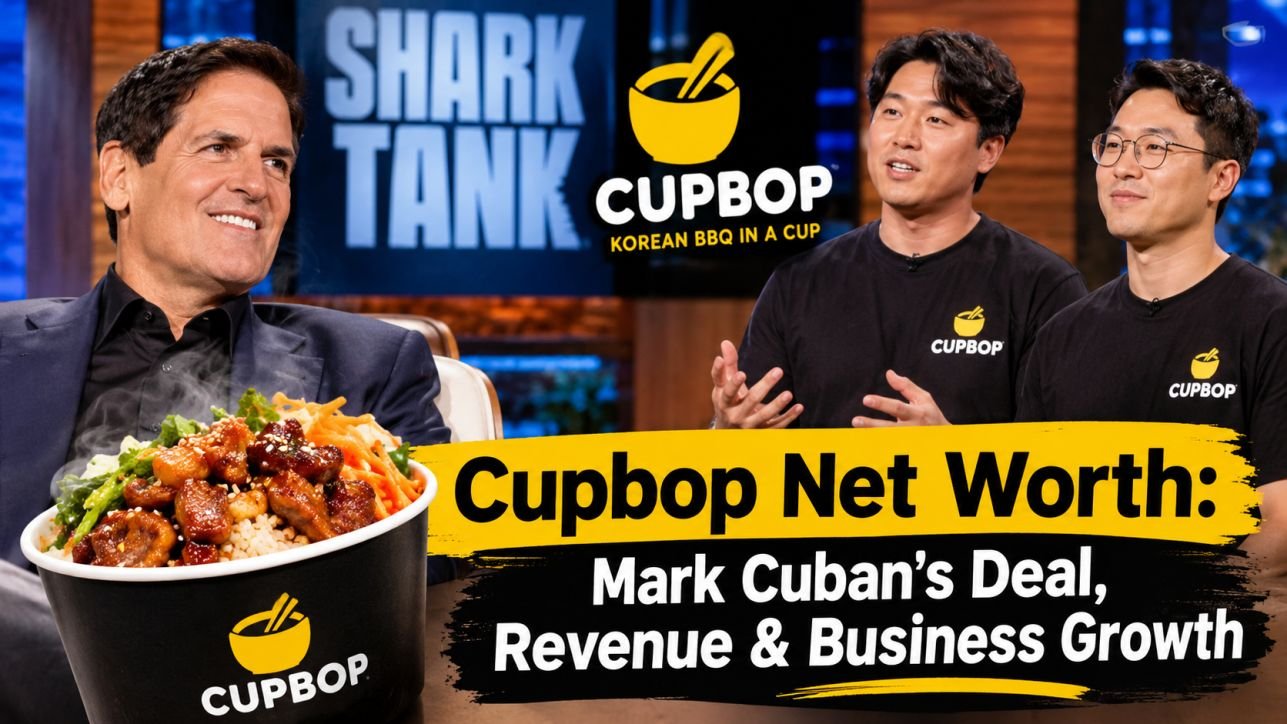
The best-known valuation benchmark comes from its appearance on Shark Tank in May 2022. Founders Junghun “Jung” Song and Dok Kwon accepted Mark Cuban’s offer of $1 million for 5% of the company on camera, implying a $20 million valuation. However, whether the deal ultimately closed after due diligence has not been publicly confirmed, as reported by CNBC’s coverage of the pitch.
Cupbop has expanded considerably since then. In a September 24, 2026 interview with 1851 Franchise, COO Dok Kwon reported 72 U.S. restaurants, approximately 250 locations in Indonesia, and three restaurants in Dubai. The company has also pursued expansion into Canada.
Its reported sales have grown alongside its footprint, but sales figures alone cannot establish its valuation. Corporate revenue, franchise restaurant sales, royalties, operating expenses, debt, and ownership stakes all affect what a business is worth.
For that reason, online estimates claiming Cupbop is worth $180 million or $200 million should be treated as speculative unless supported by a documented transaction or reliable financial information.
Cupbop at a Glance
| Detail | Information |
|---|---|
| Company | Cupbop |
| Industry | Korean BBQ / fast-casual restaurants |
| Founded | 2013 |
| Founders | Junghun “Jung” Song and Dok Kwon |
| Headquarters | Utah, United States |
| Shark Tank appearance | Season 13, Episode 21 |
| Original investment request | $1 million for 3% |
| Accepted on-air offer | $1 million for 5% from Mark Cuban |
| Implied valuation | $20 million |
| Sales reported during the pitch | $18.7 million trailing 12-month systemwide sales |
| U.S. restaurants reported in 2026 | 72 |
| Indonesia locations | Approximately 250 |
| Dubai locations | 3 |
| Current company valuation | Not publicly disclosed |
Cupbop on Shark Tank: The $1 Million Deal
Cupbop appeared on Shark Tank on May 2, 2022, during Season 13, Episode 21. ABC’s official episode page identifies Cupbop among the businesses featured that night. The founders, Jung Song and Dok Kwon, introduced their Korean barbecue concept and served the Sharks their food.
The business began in Utah in 2013 as a food truck selling Korean barbecue in a cup. Song, who had previously worked as a dancer in Korea, started the venture with his savings. The concept was straightforward: serve Korean-inspired food quickly, let customers choose their spice level, and make the experience memorable.
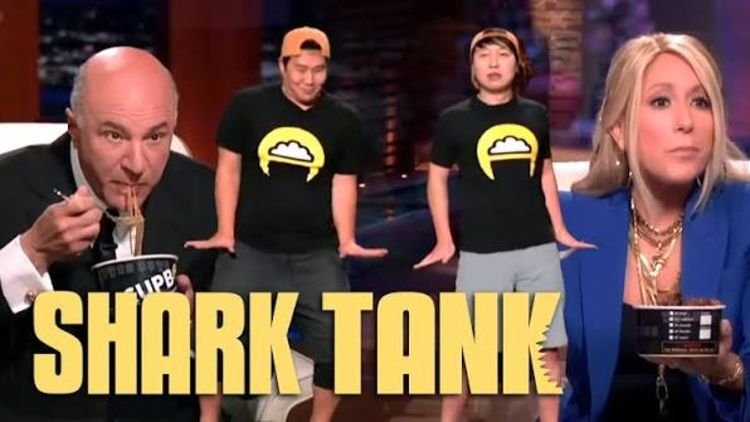
Kwon joined the business after working in investment banking and finance. He had been an early Cupbop customer before becoming involved in its growth. In a later QSR Magazine profile, Kwon described joining the company as a co-owner and chief operating officer.
By the time they appeared on Shark Tank, the founders were asking for $1 million in exchange for 3% equity. That request implied a company valuation of approximately $33.3 million.
Cupbop’s Sales During the Pitch
Song and Kwon told the Sharks that Cupbop had generated $18.7 million in systemwide sales over the preceding 12 months. At the time, the company had 27 brick-and-mortar locations.
The founders also described their sales progression over the preceding years, saying sales had grown from roughly $7 million to $8 million, $9 million, and around $10.5 million before the latest growth period.
The business had also adapted during COVID-19. When dining rooms closed, Cupbop shifted toward takeout and delivery. The founders reported that same-store sales increased by 9% during the pandemic.
The $18.7 million figure is best described as systemwide sales, not automatically as corporate revenue. The distinction matters because sales generated by franchised restaurants do not necessarily belong on the corporate company’s revenue statement.
The Five Sharks’ Offers
Cupbop received offers from all five Sharks, although some involved loans rather than straightforward equity investments. Five-Shark bidding wars are rare on the show, often driving valuation caps significantly higher than standard CPG pitches, as seen across Daymond John’s best Shark Tank deals.
| Shark | Offer |
|---|---|
| Kevin O’Leary | $1 million loan at 10% interest over three years, plus 3% equity |
| Barbara Corcoran | $1 million for 30% equity |
| Robert Herjavec | $5 million for 28% equity |
| Lori Greiner and Barbara Corcoran | Joint $1 million loan at 8% interest for 5% equity |
| Mark Cuban | Initially $1 million for 7%; ultimately $1 million for 5% |
Mark Cuban’s offer became the one the founders accepted on camera.
Cuban argued that Cupbop had strong operations but needed national exposure, marketing, and public relations to accelerate its growth. Song and Kwon negotiated the equity percentage, and Cuban ultimately agreed to 5%.
The deal implied a valuation of:
$1 million ÷ 5% = $20 million
That is the most concrete publicly documented valuation benchmark associated with Cupbop.
Did Mark Cuban Actually Invest in Cupbop?
The televised agreement is documented. The completion of the investment after filming is not publicly confirmed.
There is a reporting discrepancy regarding the deal’s structure. CNBC described Cuban’s offer as $1 million for 5% equity, while the Deseret News report reported that the founders ultimately settled on a $1 million loan with a 5% stake.
That difference matters. A loan and an equity investment have different financial implications for a business, even when both arrangements include an ownership component.
Cupbop does not appear in Mark Cuban Companies’ publicly listed portfolio, and no public announcement confirming the completed investment has been identified.
However, the absence of a portfolio listing or press release does not prove that the deal fell through. Shark Tank agreements are subject to post-show due diligence, and the terms can change or fail to close—a common phenomenon analyzed in our audit of Shark Tank due diligence and deal fallouts.
The most accurate conclusion is that Song and Kwon accepted Cuban’s offer on television, but the final status of the investment remains publicly unconfirmed.
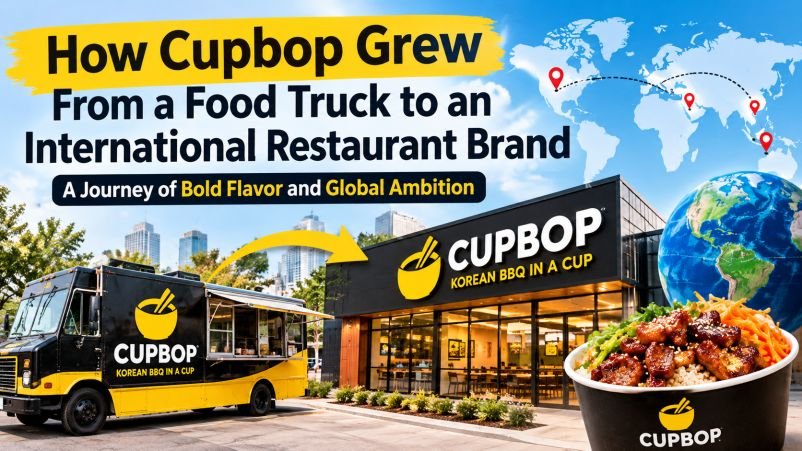
How Cupbop Grew From a Food Truck to an International Restaurant Brand
Cupbop’s growth is particularly interesting because the company spent years building its restaurant operations before making franchising a larger part of its expansion strategy.
U.S. Restaurant Expansion
Cupbop began with a food truck in Utah in 2013. The business gradually moved into permanent restaurants, building a domestic footprint that included company-operated and franchised locations—following a food-truck-to-brick-and-mortar expansion playbook similar to Cousins Maine Lobster.
In June 2023, QSR Magazine reported that Cupbop had approximately 47 U.S. locations, including 19 franchised units. The publication also listed annual systemwide sales of approximately $40 million.
A later interview provides additional context about the company’s operating strategy. In September 2026, Dok Kwon told 1851 Franchise that Cupbop had built roughly 40 corporate stores before making franchising a larger part of its growth strategy. He reported 72 U.S. locations at the time.
The two reports describe the business at different points in its development. They do not, by themselves, establish the precise ownership or operating arrangement of every location in between.
Cupbop’s reported domestic footprint includes restaurants across states such as Utah, Idaho, Arizona, Colorado, Nevada, Oklahoma, Texas, and Oregon. Its expansion has also included nontraditional locations and food trucks.
Indonesia: Cupbop’s Largest International Market
Indonesia has become a significant part of Cupbop’s international business.
The brand expanded into Indonesia through a regional licensing and franchise model. Local operators helped introduce the concept to a market where Korean culture and food already had a substantial following.
By October 2025, ChosunBiz reported approximately 220 Indonesian locations. In the September 2026 1851 Franchise interview, Kwon reported roughly 250 locations.
These outlets are not necessarily owned or operated directly by Cupbop’s U.S. corporate entity. Under licensing and franchise arrangements, local operators run restaurants while the brand owner may earn royalties, fees, or other contractual income.
This distinction is important when evaluating Cupbop’s overall sales. The money customers spend at international franchise restaurants is not automatically recognized as revenue by the U.S. corporate company.
Dubai and Canada
Cupbop expanded into Dubai through a partnership with hospitality operator RMAL Hospitality, associated with the Al Fahim Group. The partnership reportedly included plans for 10 locations across the United Arab Emirates.
By September 2026, Kwon reported three Dubai locations operating in the 1851 Franchise interview.
Canada is another expansion market. Cupbop’s international plans were discussed in a 2025 ChosunBiz interview, which reported an agreement with a Canadian food and beverage operator to develop stores.
A signed development agreement, however, is not the same as operating restaurants. The distinction matters when counting the brand’s current footprint.
Cupbop Revenue: What the Reported Numbers Actually Show
Cupbop’s sales history provides useful context for its growth, but the reported figures come from different periods and use different definitions.
| Period | Reported figure | What it represents |
|---|---|---|
| 2013 | Approximately $13,000 | Founder’s initial savings |
| Earlier growth years | $7M, $8M, $9M, approximately $10.5M | Sales progression described during the Shark Tank pitch |
| 2022 pitch | $18.7M | Trailing 12-month systemwide sales |
| Late 2022 | $25M+ | Reported growth forecast, not confirmed actual revenue |
| June 2023 | Approximately $40M | Systemwide sales reported by QSR Magazine |
| October 2025 | ₩60 billion | Annual sales figure reported by ChosunBiz |
The figures should not be read as a perfectly comparable year-by-year revenue series. Some refer to company sales, some to systemwide restaurant sales, and others to projections or sales reported without a clearly specified accounting period. Evaluating food and beverage enterprises requires isolating top-line brand velocity from actual company EBITDA, a principle audited in our financial review of Kodiak Cakes.
The $40 Million Sales Milestone
QSR Magazine’s June 2023 profile reported approximately $40 million in systemwide sales across 47 U.S. locations. The article also listed 19 franchised units.
Systemwide sales generally represent the total sales generated across the restaurant network. They are not necessarily the same as revenue reported by the corporate entity. Company-operated restaurants may contribute their full sales to corporate revenue, while franchised restaurants generally contribute royalties, fees, and other contracted income.
The ₩60 Billion Sales Figure
In October 2025, ChosunBiz reported that Cupbop had reached annual sales of approximately ₩60 billion.
That is 60 billion Korean won—not $60 billion and not automatically $60 million in U.S. dollars. At exchange rates around the 2025 period, the figure translates roughly to $43 million, although the exact conversion depends on the exchange rate used.
The interview discussed Cupbop’s business and international expansion, but it did not provide a detailed accounting breakdown specifying the exact fiscal period, corporate revenue definition, or how the sales figure was calculated.
It is therefore best treated as a reported sales milestone rather than a directly comparable audited revenue figure.
What Cupbop’s 2026 Franchise Disclosure Can Tell Us
Cupbop’s Franchise Disclosure Document (FDD) is potentially useful for understanding its restaurant economics. In particular, Item 19 is the section where a franchisor may provide financial performance representations for specified groups of restaurants.
A third-party FDD index identifies a 2026 Cupbop filing and reproduces Item 19 data for qualifying restaurants. However, the detailed figures should be checked against the original FDD, including its definitions, reporting period, sample size, and footnotes, before being quoted as verified financial results. The third-party filing index can help locate the relevant filing, but it should not replace the original document as the final source.
One distinction is essential: restaurant gross revenue is not franchisee profit. A restaurant’s sales must cover food and packaging, labor, rent, utilities, insurance, royalties, marketing contributions, debt payments, and other operating expenses. Gross sales alone do not show how much the operator keeps.
The FDD can help explain the economics of an individual franchise location. It cannot, by itself, establish Cupbop’s overall corporate valuation.
Cupbop Net Worth in 2026: What Can Actually Be Established?
The strongest documented valuation benchmark remains Mark Cuban’s $20 million implied valuation from the May 2022 Shark Tank offer.
Cupbop has since expanded its U.S. footprint, grown its international network, developed new franchise relationships, and reported larger sales milestones. Its franchise disclosure also offers a potential source of information about individual restaurant performance.
Those developments suggest the business has grown, but they do not establish its current valuation.
A restaurant company valuation depends on more than the number of locations or total sales. Investors would also consider operating margins, profitability, debt, franchise royalties, growth costs, ownership structure, brand strength, and the terms of any investment or acquisition—metrics we similarly evaluate in our The Comfy net worth audit.
Cupbop has not publicly disclosed enough information to calculate a reliable current valuation using those factors.
Online estimates of $180 million to $200 million may look plausible when paired with the company’s expansion, but without a documented transaction, financial statements, or a credible valuation methodology, they remain estimates—not established facts.
The $20 million Shark Tank benchmark is useful historical context. It should not be presented as Cupbop’s current net worth.
Frequently Asked Questions
What Is Cupbop’s Net Worth in 2026?
Cupbop’s current valuation has not been publicly disclosed. Its best-known valuation benchmark is the $20 million implied valuation from Mark Cuban’s 2022 Shark Tank offer.
Did Mark Cuban Invest $1 Million in Cupbop?
The founders accepted Cuban’s $1 million offer for 5% on the show. However, the completion of the deal after due diligence has not been publicly confirmed.
How Many Cupbop Locations Are There?
In September 2026, COO Dok Kwon reported 72 U.S. locations, approximately 250 in Indonesia, and three in Dubai. These figures include different operating and ownership arrangements.
How Much Revenue Does Cupbop Make?
Cupbop reported $18.7 million in trailing 12-month systemwide sales during its 2022 Shark Tank pitch. QSR Magazine reported approximately $40 million in systemwide sales in June 2023. ChosunBiz later reported annual sales of approximately ₩60 billion in October 2025.
These figures have different reporting periods and definitions, so they should not be treated as a directly comparable revenue series.
Does Cupbop Disclose Franchise Earnings?
Cupbop’s 2026 FDD is indexed as containing an Item 19 financial performance representation. Item 19 information concerns specified restaurant performance, generally gross sales or revenue—not necessarily franchisee net profit. Check the original filing before quoting specific figures.
How Much Does a Cupbop Franchise Cost?
The exact initial investment and fee figures should be taken directly from the current FDD. They should not be repeated from third-party summaries without checking the original filing and its current terms.
Final Thoughts
Cupbop’s story is a restaurant-growth story, not a publicly documented valuation story.
The company began with a Utah food truck, built a domestic restaurant operation, expanded internationally, and developed a franchise model. Its Shark Tank appearance gave it a $20 million implied valuation benchmark in 2022, while its later sales reports provide more evidence of the business’s scale.
But a growing restaurant network and rising sales do not automatically translate into a specific net worth. Without a confirmed investment closing, acquisition, or disclosed current valuation, Cupbop’s value in 2026 remains unknown.
That is the most accurate answer—and the distinction between documented business performance and speculative valuation is what makes the numbers worth examining.