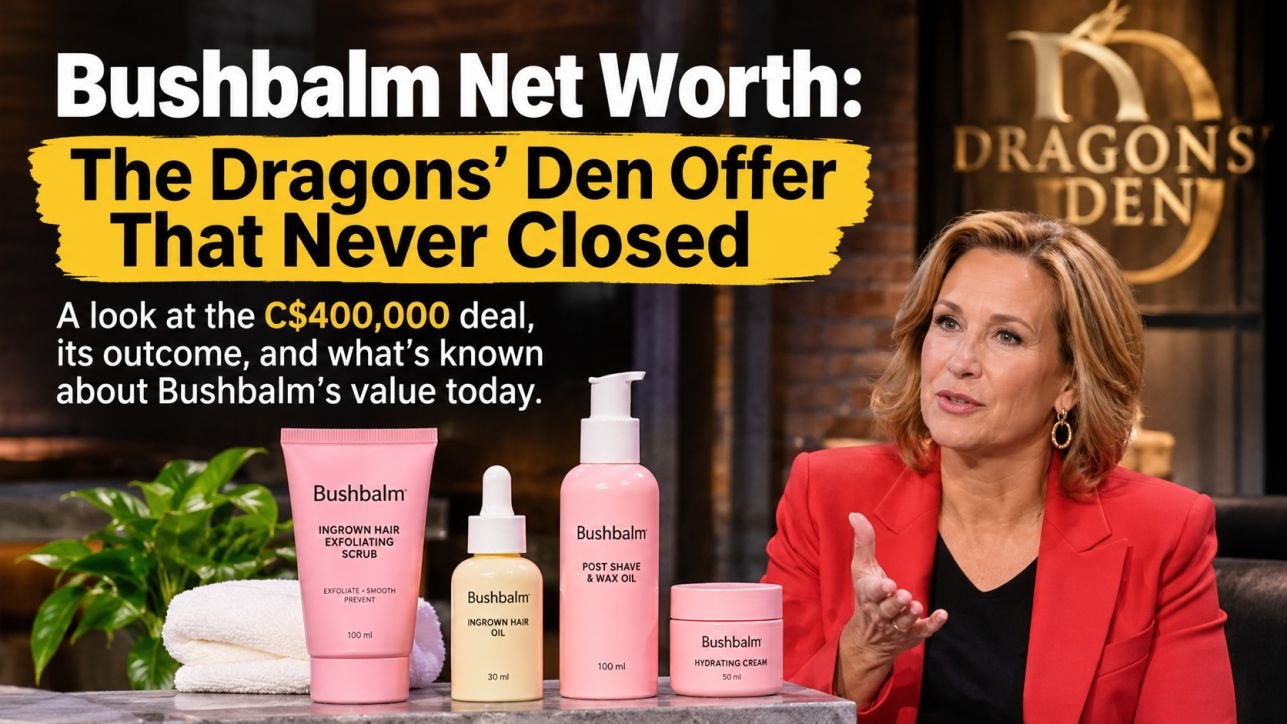
Bushbalm is often mentioned in searches for skincare brands that appeared on Shark Tank. However, the Ottawa-based company actually appeared on Canada’s CBC television show, Dragons’ Den. During its Season 15 appearance, co-founders David Gaylord and Tim Burns asked for C$400,000 in exchange for 10% equity. Dragon Arlene Dickinson offered the requested amount, and the founders accepted on camera.
The deal looked like a major breakthrough for the young skincare company, but it never reached completion. In a later interview on The Unofficial Shopify Podcast, co-founder and CEO David Gaylord confirmed that the investment did not go through after filming.
The televised offer implied a C$4 million post-money valuation in 2020. That figure represented the proposed investment terms, not a completed transaction or the company’s current value.
So, what is Bushbalm worth in 2026?
There is no publicly confirmed figure for Bushbalm’s current net worth or enterprise valuation. However, its revenue history, expansion into major retail stores, and growing professional distribution network provide a useful picture of how far the business has come since its television appearance.
Bushbalm at a Glance: Company and Dragons’ Den Deal
| Company Detail | Information |
|---|---|
| Company Name | Bushbalm |
| Founded | 2016 |
| Headquarters | Ottawa, Ontario, Canada |
| Industry | Skincare and personal care |
| Founders | David Gaylord, Tim Burns, and Melodie Burns |
| Television Show | CBC’s Dragons’ Den |
| Season | Season 15 |
| Original Air Date | December 10, 2020 |
| Founders Who Pitched | David Gaylord and Tim Burns |
| Original Ask | C$400,000 for 10% equity |
| Dragon Who Made the Offer | Arlene Dickinson |
| On-Air Offer | C$400,000 for 10% equity |
| Implied Post-Money Valuation | C$4 million |
| Final Investment Outcome | Deal did not close |
| Main Product Category | Bikini-line skincare, ingrown hair treatments, and post-hair-removal care |
| Major US Retail Partner | Ulta Beauty |
| Canadian Retail Partner | Shoppers Drug Mart |
| Professional Distribution | More than 18,000 independent salon accounts, reported in February 2026 |
| Current Company Valuation | Not publicly disclosed |
How Bushbalm Started: From a Small Idea to a Skincare Business
Bushbalm’s story began in 2016 with an unexpected idea.
Tim Burns and his wife, Melodie, were on their honeymoon when Melodie used Tim’s beard oil as a skincare product for an intimate area. The experience led them to consider whether there was an opportunity for a dedicated personal-care product for sensitive areas of the body.
At the time, many people experienced problems such as ingrown hairs, razor burn, redness, and irritation after shaving or waxing. Yet, relatively few skincare brands focused specifically on these concerns.
Tim discussed the idea with his Shopify colleague David Gaylord, who saw potential in building a business around it.
The three founders brought different skills to the project. Tim focused on operations, David handled marketing and e-commerce, and Melodie contributed her graphic design experience.
According to David Gaylord’s interview on The Unofficial Shopify Podcast, the business took shape over several months while the founders continued working full-time jobs.
Bushbalm initially focused on oils and exfoliating products. Over time, the company developed a broader range of skincare solutions for bikini-line care, ingrown hairs, dark spots, and post-hair-removal irritation.
Its positioning was different from that of traditional skincare brands. Instead of trying to compete across every beauty category, Bushbalm concentrated on a specific customer problem.
That focus helped the company establish a recognizable identity in the personal-care market.
Bushbalm’s Dragons’ Den Appearance: The C$400,000 Offer
Bushbalm’s appearance on CBC’s Dragons’ Den was one of the company’s most memorable early milestones.
The founders appeared on the show in 2020, with the episode airing on December 10. They presented their skincare products to the Dragons and explained the opportunity in a category that was still relatively underserved.
David Gaylord and Tim Burns entered the Den seeking C$400,000 for 10% equity.
That request implied a C$4 million post-money valuation.
Why Arlene Dickinson Made an Offer
Dragon Arlene Dickinson was impressed by the founders’ presentation, particularly the branding, product packaging, and potential for retail expansion.
She recognized that Bushbalm was not simply selling another skincare oil. The company had a clearly defined customer problem and a product range built around it.
Dickinson offered the founders the full C$400,000 they requested in exchange for 10% ownership.
The founders accepted the offer on camera.
The Ottawa Business Journal’s original December 2020 coverage reported on the appearance and Dickinson’s interest in the brand.
Did Bushbalm Actually Receive the Dragons’ Den Investment?
No. The televised agreement never became a completed investment.
This is an important detail because many articles discussing Bushbalm’s appearance describe the C$400,000 as though the company actually received the money.
In his interview with The Unofficial Shopify Podcast, Gaylord explained that the deal did not go through after the show.
He also mentioned that the founders remained on good terms with Dickinson and her team.
The experience was still valuable. Preparing for the pitch pushed the founders to understand their business finances, organize their figures, and become more comfortable discussing the company with potential investors.
The television appearance also gave Bushbalm exposure among Canadian consumers.
However, from a financial perspective, the distinction is straightforward: Dickinson made an offer, the founders accepted it on television, but the investment never closed.
You can read the full explanation in David Gaylord’s podcast interview and transcript.
Bushbalm Revenue Growth: What Do the Numbers Actually Show?
Bushbalm’s financial development after Dragons’ Den is more interesting than the original investment offer.
The company initially relied heavily on direct-to-consumer sales, using its website, digital marketing, and online customer relationships to grow its audience.
As demand increased, it began developing relationships with retail stores and independent beauty professionals.
Several public interviews and industry reports provide insight into this growth. However, it is important to distinguish between actual historical sales reported by the founder, company revenue forecasts, and subsequent performance statements.
Bushbalm’s Early Revenue Growth
During the original Dragons’ Den period, Gaylord said the company was on track to generate approximately $1.8 million in revenue.
In his later podcast interview, he recalled that sales increased from approximately $1.8 million to $8.3 million in the following year. He also discussed subsequent growth to approximately $11.5 million.
These are historical figures recalled by the founder, not independently audited financial statements.
Nevertheless, they illustrate how quickly Bushbalm expanded after finding its target market and gaining wider brand recognition.
Bushbalm’s Financial Timeline
| When Reported | Revenue or Financial Figure | How to Interpret It |
|---|---|---|
| 2020 | Approximately $1.8 million | Founder-reported sales projection at the time of the Dragons’ Den pitch |
| Following year | Approximately $8.3 million | Founder-reported historical sales |
| Subsequent period | Approximately $11.5 million | Additional historical figure recalled by Gaylord |
| March 2024 | $14.7 million expected revenue | Forecast reported by Beauty Independent |
| February 2025 | $20 million–$30 million expected revenue for 2025 | Forecast reported by BeautyMatter; currency not specified |
| February 2026 | 70% year-over-year revenue growth and 10% EBITDA | CEO-reported operating performance for the preceding year |
These figures should not be added together or treated as a continuous audited financial statement. The two industry publications reported forecasts, while the podcast figures were shared retrospectively by Gaylord.
The 2024 Revenue Forecast
In March 2024, Beauty Independent reported that Bushbalm expected to generate approximately $14.7 million in revenue during the year.
The company was also expanding its relationship with Ulta Beauty, bringing more products into the retailer’s stores.
The report highlighted the importance of physical retail to Bushbalm’s next stage of growth.
Its expected revenue represented a projected increase of approximately 35% over the preceding year.
Read the Beauty Independent report on Bushbalm’s Ulta expansion and fundraising plans.
BeautyMatter’s 2025 Revenue Projection
Another useful reference appeared in February 2025, when BeautyMatter included Bushbalm in its FUTURE50 list.
The publication listed the company’s expected 2025 revenue at $20 million to $30 million.
It also highlighted the company’s professional distribution network, including relationships with more than 6,000 independent waxing salons at the time.
Importantly, BeautyMatter presented this figure as expected revenue, not a confirmed year-end financial result. The profile also did not specify the currency.
The full details are available in BeautyMatter’s Bushbalm FUTURE50 company profile.
The February 2026 Update: 70% Revenue Growth
The latest detailed operating update used in this analysis comes from a February 9, 2026 interview with David Gaylord on Episode 584 of The DTC Podcast.
During the conversation, Gaylord reported approximately 70% year-over-year revenue growth for the preceding year.
He also discussed a 10% EBITDA margin, indicating that the company had made progress toward building a more profitable operating model.
Another interesting detail was the company’s reduced reliance on paid advertising. Gaylord explained that marketing expenditure, which had previously reached approximately 40% of revenue, had fallen to around 21%.
He attributed this improvement partly to retail distribution, professional relationships, and stronger word-of-mouth marketing.
These are CEO-reported operating figures, not audited financial statements. Also, a positive EBITDA margin should not be confused with net profit or free cash flow.
The full conversation is available in Episode 584 of The DTC Podcast.
How Bushbalm Expanded Into Retail Stores and Professional Distribution
Bushbalm’s growth was not limited to online sales. Its expansion into physical retail and professional beauty channels became an important part of its business strategy.
Expansion Into Ulta Beauty
Ulta Beauty became one of Bushbalm’s most important retail partners in the United States.
The brand initially entered approximately 990 Ulta stores in 2023. By March 2024, its products were expanding across nearly 1,400 locations.
The expansion included its core skincare products and additional placement in Ulta’s wellness section.
This gave Bushbalm access to customers who might never have discovered the brand through its website or social media.
It also required the company to develop new capabilities in retail merchandising, inventory planning, product placement, and promotional marketing.
By the February 2026 podcast interview, Gaylord described physical retail as a central pillar of the company’s operating model. Similar to Bombas’s DTC-to-retail scaling strategy, moving beyond digital ad reliance allowed Bushbalm to stabilize its customer acquisition costs while using Ulta as a primary anchor partner in the US market.
Shoppers Drug Mart and the Canadian Market
Bushbalm also developed its Canadian retail strategy around Shoppers Drug Mart.
The retailer gives the company access to customers in its home market and provides a physical sales channel alongside its online business.
In the 2026 DTC interview, Gaylord described a focused approach to retail partnerships: building strong relationships with a major retailer in each market instead of spreading the company across too many retail partners.
The Professional Salon Network
Perhaps the most interesting part of Bushbalm’s expansion is its professional distribution network.
The company has developed relationships with independent waxing salons and beauty professionals who use and carry its products.
This makes commercial sense. Customers visiting salons for waxing services are already potential buyers of skincare products designed to help with irritation, ingrown hairs, and post-treatment care.
Salons can recommend Bushbalm products as part of their services and offer them for customers to use at home.
During the February 2026 interview, Gaylord reported that Bushbalm had more than 18,000 independent salon accounts.
He also explained that most of these businesses had between one and three locations.
This is different from having 18,000 large retail stores. The figure represents a wide network of independent professional businesses.
For Bushbalm, these relationships create another way to reach customers without relying entirely on paid digital advertising.
What Is Publicly Known About Bushbalm’s Funding?
Bushbalm’s funding history also deserves clarification.
Some online summaries refer to a C$2.5 million seed round in 2022. However, the available reporting reviewed for this article does not establish that this particular investment round was completed.
What is publicly documented is more specific.
In March 2024, Beauty Independent reported that Bushbalm was beginning its first external fundraising process, targeting $10 million.
That figure was a fundraising target, not confirmation that the company had raised the money.
In February 2025, BeautyMatter classified the company as self-funded in its FUTURE50 profile.
Taken together, these reports establish that Bushbalm had historically relied on internal funding and explored external fundraising. They do not establish a completed $2.5 million seed investment.
It is also important to distinguish equity financing from debt. A business loan or credit facility does not automatically give a lender an ownership stake in the company.
Without a confirmed investment announcement or updated capitalization information, it would be misleading to identify a specific institutional investor as a current shareholder.
What Is Bushbalm Worth in 2026?
Bushbalm has not publicly announced its current net worth or enterprise valuation.
Its revenue history and business expansion provide useful indicators of its size, but they are not enough to establish what an investor would pay for the company.
A serious valuation would require information about:
- Annual revenue and gross profit.
- Operating expenses and EBITDA.
- Cash flow and outstanding debt.
- Inventory and working-capital requirements.
- Customer retention and repeat purchases.
- Retailer concentration and professional distribution.
- Brand strength and future growth potential.
The distinction between revenue, enterprise value, and equity value also matters.
Revenue represents sales generated by the business. Enterprise value considers the value of the operating company alongside its debt and cash position. Equity value represents the value attributable to shareholders.
A business generating millions in annual revenue is not automatically worth the same amount in market value.
The February 2026 growth figures are encouraging, particularly the reported 70% revenue increase and 10% EBITDA margin. However, they do not provide enough information to calculate a defensible valuation.
The most accurate conclusion is that Bushbalm has grown into a substantial private skincare business, but its current 2026 net worth and enterprise valuation remain undisclosed.
Who Owns Bushbalm? Founders and Ownership Details
Bushbalm was founded by David Gaylord, Tim Burns, and Melodie Burns.
David Gaylord serves as CEO, while Tim Burns has been identified as the company’s COO. Melodie Burns is also recognized as a co-founder.
The three founders played different roles in developing the company’s products, operations, marketing, and brand identity.
However, the company’s current ownership percentages have not been publicly established in the sources reviewed.
Private-company shares can contribute to a founder’s personal net worth even when those shares have not been sold. But without a verified company valuation and accurate ownership information, it is not possible to calculate the founders’ individual wealth from Bushbalm.
The original Arlene Dickinson offer also does not establish a current ownership stake for the Dragon because the investment never closed.
Frequently Asked Questions About Bushbalm Net Worth and Shark Tank
1. Did Bushbalm appear on Shark Tank?
No. Bushbalm appeared on CBC’s Canadian investment show Dragons’ Den, not ABC’s US version of Shark Tank. The pitch aired on December 10, 2020, and featured co-founders David Gaylord and Tim Burns.
2. What was Bushbalm’s Dragons’ Den deal?
Bushbalm requested C$400,000 for 10% equity. Dragon Arlene Dickinson offered the requested terms, implying a C$4 million post-money valuation. The founders accepted the offer on television, but David Gaylord later confirmed that the investment never closed.
3. What is Bushbalm’s net worth in 2026?
Bushbalm has not publicly disclosed its current net worth or enterprise valuation. BeautyMatter projected 2025 revenue of $20 million to $30 million, while the CEO reported 70% year-over-year growth and a 10% EBITDA margin in February 2026. These figures demonstrate business growth, but they do not establish a verified company valuation.
4. Who owns Bushbalm skincare?
Bushbalm was co-founded by David Gaylord, Tim Burns, and Melodie Burns. The company is privately held, and its exact current ownership percentages have not been publicly disclosed.
5. Is Arlene Dickinson still an investor in Bushbalm?
There is no verified evidence that Dickinson received the proposed 10% ownership stake. Although she made an offer on Dragons’ Den, Gaylord later confirmed that the investment never closed.
Final Thoughts
Bushbalm’s journey from a small Ottawa startup to an expanding skincare business is a useful example of how a company can build a market by focusing on an underserved customer need.
Its appearance on Dragons’ Den brought national attention, but the televised C$400,000 investment from Arlene Dickinson never closed.
The business continued growing through its own sales, retail partnerships, and professional distribution network.
The February 2026 interview provides the clearest recent financial picture: approximately 70% year-over-year revenue growth, a 10% EBITDA margin, and more than 18,000 independent salon accounts.
These are meaningful indicators of the company’s progress, but they should not be confused with a verified company valuation.
For readers searching for Bushbalm’s net worth, the most important distinction is simple: the Dragons’ Den offer was not a completed investment, revenue is not valuation, and Bushbalm’s current net worth remains undisclosed.
For another example of how entrepreneurs handle investment offers on television, read our article on Kodiak Cakes’ net worth and Shark Tank appearance.