


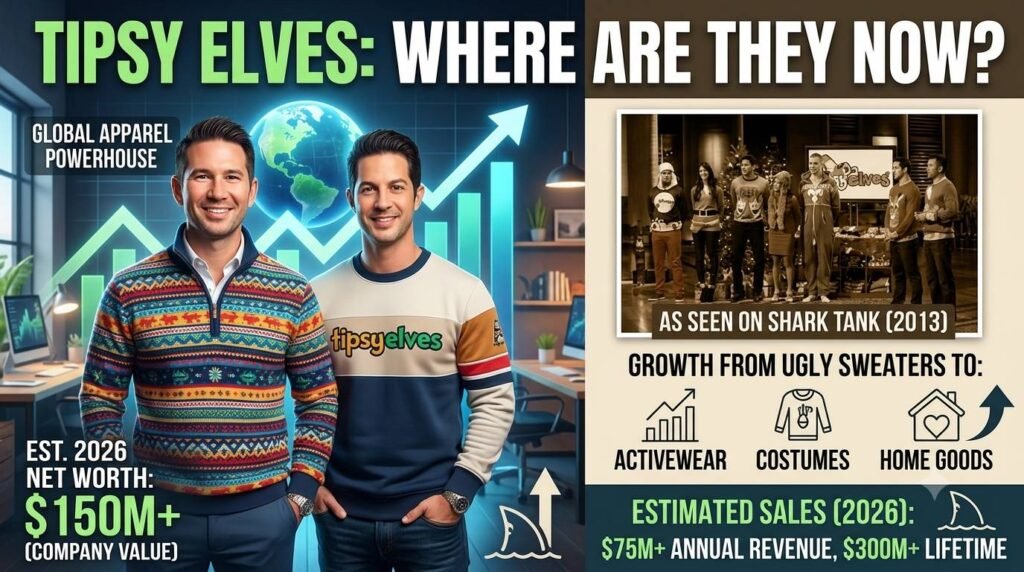
Two college friends, one a lawyer and one fresh out of dental school, started selling ugly Christmas sweaters online in 2011. In December 2013 they took $100,000 from Robert Herjavec on Shark Tank. He has since called it his most profitable investment on the show, and Tipsy Elves is now sold in more than 200 countries and covers a lot more than Christmas.
This post walks through how the company started, how the pitch went (the Sharks’ offers were not what the founders asked for), what happened to sales afterward, and what the company is actually worth. That last question is harder than the headlines make it sound. Tipsy Elves is private, and the sales figures published about it cover different points in time and need to be read in sequence rather than as contradictions. I’ve flagged where the numbers are solid and where they aren’t.
Who started Tipsy Elves
Evan Mendelsohn was 27 in 2011 and working as a lawyer at a large California firm, a job he found boring. On the side he ran small websites that lived off search traffic. While looking at search trends he noticed that people searching for “ugly Christmas sweaters” had roughly doubled from 2010 to 2011. Nobody was selling the kind of sweater those searchers seemed to want, so he called Nick Morton.
Morton was his old fraternity brother and college roommate, and he had just finished dental school. He later became an endodontist. According to The Hustle, he agreed on the first call. With a few months before Christmas, they taught themselves Photoshop, designed the first sweaters and paid for the first batch out of their own savings. The company started in San Diego, and that first inventory sold out in about a week and a half.
The early numbers were real but modest. Wikipedia puts the first season at about $370,000 in web sales and the second year at close to $1 million. Shark Tank Blog says the company did over $800,000 in 2012, with about half of it coming through Amazon. Mendelsohn himself later described it as “a little under a million” at the time of the show.
The Shark Tank pitch
Tipsy Elves aired on December 13, 2013, in Season 5, Episode 12. The founders came in asking for $100,000 for 5% of the company, which valued it at $2 million. They wanted the money to move into retail.
The Sharks split on it:
| Shark | Offer | What happened |
|---|---|---|
| Robert Herjavec | $100,000 for 10% | Took the deal |
| Kevin O’Leary | $100,000 for a $2 royalty per sweater until repaid, then $1 per sweater forever | No equity, which is why it lost |
| Mark Cuban | Out | Had no problem with the valuation but wasn’t convinced by their answer on how they’d grow |
| Lori Greiner | Out | Didn’t think the product was unique enough |
| Daymond John | Out | Liked the product and the founders but had reservations |
Herjavec’s offer took twice the equity they’d offered and cut the valuation to $1 million. They accepted anyway. O’Leary’s royalty would have let them keep all their equity, but it was a permanent per-sweater charge with no end date.
Herjavec explained his bet to CNBC years later: “I didn’t bet on the product, I bet on the guys.” He pointed out that both of them had left secure careers to sell sweaters online.
What happened after the episode
Sales jumped quickly. Shark Tank Blog reports $6 million within a year of the episode, and when the show checked back in the Beyond the Tank premiere, annual sales were above $7 million. The founders also appeared in an update segment in Season 6 and again in Season 7 as the growth continued. Those figures come from different points in time, so read them together as “several million dollars within two years,” up from under $1 million before the show.
The founders’ day jobs didn’t survive it. Mendelsohn left his law practice to run the company day to day. Morton kept his dental work for a while, then gave up his practice and moved across the country to work on Tipsy Elves full time. By 2019 Mendelsohn said the team had grown from one employee to about 30.
Herjavec’s contribution was mostly advice rather than operations. Mendelsohn has said he helped them decide which collections to chase and sharpen the brand. On Beyond the Tank he shot down a planned lower-priced line called Knit-Knack and told them to stay focused on their own brand. His advice, as CNBC quoted it: “Stay focused, pick your lane and stay in it.”
As for where they sell, it was never a pure website business. Roughly half of 2012 sales went through Amazon, and the company also sells through its own site and runs holiday pop-up stores. By 2019 those were open in Los Angeles, San Diego and Chicago, and Mendelsohn talked about growing to 10 or even 25 locations.
Beyond Christmas
The obvious weakness in a sweater company is that most people only buy one in December. Tipsy Elves went after that directly. The catalog now includes Hawaiian shirts, shorts, leggings, ski suits, onesies and Halloween costumes, plus gear for St. Patrick’s Day, the Fourth of July and Pride, and a bachelorette range was in the works as of 2019. By then Mendelsohn said the newer categories were growing faster than Christmas, although Christmas itself still grew every year.
A few brand partnerships helped. There was a “Swipe Right for Santa” sweater with Tinder and spicy onesies with Taco Bell, and a pet line sold through PetSmart. The founders also made a cameo on Shark Tank Season 15, Episode 10, which aired in January 2024, appearing alongside their duck sweaters tied to the animated film Migration.
Tipsy Elves net worth and revenue
No one has published a valuation for Tipsy Elves. It’s private, it hasn’t been sold, and the founders haven’t disclosed financials. What does exist is a trail of lifetime sales milestones — sequential checkpoints, not competing claims — and they tell a clear growth story:
| When | Figure | Source |
|---|---|---|
| 2011 (first season) | About $370,000 | Wikipedia |
| 2012 | Over $800,000 | Shark Tank Blog |
| Within a year of the show | $6 million annual | Shark Tank Blog |
| May 2015 | Over $7 million annual | Beyond the Tank recap |
| 2019 | Over $100 million lifetime | CNBC |
| 2023 | Over $120–125 million lifetime | Shark Tank Tales / Celebrity Net Worth |
| October 2023 | $317 million lifetime — ranked 8th most successful Shark Tank company | Shark Tank Blog / Soap Central |
A note on reading that table: the $100M, $125M and $317M figures are not contradictory — they are milestones at different points in time. The $317M figure, reported in October 2023 when Tipsy Elves was ranked the 8th most successful Shark Tank company of all time, is the most recent and the one most widely cited. It still hasn’t been independently audited, but it comes from multiple consistent sources rather than a single outlier.
Valuation
No one has published a current valuation. The only hard figure is $1 million post-money from the Shark Tank deal in 2013, when sales were under $1 million a year. Sites that quote a company “net worth” since then rarely explain their methodology, and an honest estimate would need current annual revenue, margins and any debt, none of which are public.
What we do know: Herjavec predicted a $100 million clothing company back in 2015, and the company has gone well past that. He has called Tipsy Elves “by far, my most profitable investment” and holds the 10% stake he bought in 2013, less whatever dilution has occurred since. Nobody has said what that stake is worth or what he has taken out.
Margins
The economics are the reason the numbers work at all. A molded sweater with a novelty design is relatively cheap to manufacture and easy to ship, and the product retails at a price point — typically $60–$80 — where retailers can mark it up without it feeling expensive. That margin profile is what let the company build out pop-up stores and fund seasonal inventory spikes without outside capital after the initial Herjavec deal.
What founders can take from it
Check demand before you build. Mendelsohn didn’t guess that people wanted ugly sweaters. He saw search interest double in a year, and he had a decade of running small search-driven sites behind him to know what that meant. The first inventory sold out in days.
Take the investor who wants you, not the one with the cleverest terms. O’Leary’s royalty offer let them keep all their equity. They took Herjavec’s 10% anyway, and he ended up pushing them toward the right collections and away from the wrong ones. The Knit-Knack line was a case in point.
Deal with the weak season early. A business that does most of its sales in one month is fragile. They spent the years after the show adding spring, summer and Halloween lines until the newer categories were growing faster than Christmas.
Be willing to leave the safe job. Herjavec said that’s what he bet on. Both founders walked away from law and dentistry, and the company only got to its current size once they did.
FAQs
Who owns Tipsy Elves today?
Evan Mendelsohn and Nick Morton founded it and run it — Mendelsohn as CEO, Morton as president. Through his Shark Tank deal, Robert Herjavec took a 10% stake in the company. No other ownership changes have been reported publicly, though dilution since 2013 is unknown.
Is Tipsy Elves still in business?
Yes. The company was still active in 2024, when the founders made a cameo on Shark Tank Season 15, and tipsyelves.com continues to sell year-round. Check the site for current stock.
How much did Robert Herjavec make from Tipsy Elves?
No one has published a number. He calls it his most profitable Shark Tank investment and invested $100,000 for 10% in 2013. With lifetime sales now reported above $317 million, the stake is worth considerably more than his initial check — but the exact figure is private.
Where are Tipsy Elves products sold?
On tipsyelves.com and Amazon, in holiday pop-up stores in cities including Los Angeles, San Diego and Chicago, and through PetSmart for the pet line. Shark Tank Blog confirms the company ships to more than 200 countries.
What was the Shark Tank deal?
$100,000 for 10% from Robert Herjavec, on the episode that aired December 13, 2013. The founders had asked for 5%.
How much is Tipsy Elves worth?
No confirmed figure exists. Lifetime sales passed $317 million as of October 2023 according to Shark Tank Blog and Soap Central. The company remains private, so a precise valuation isn’t possible without knowing current annual revenue and margins.