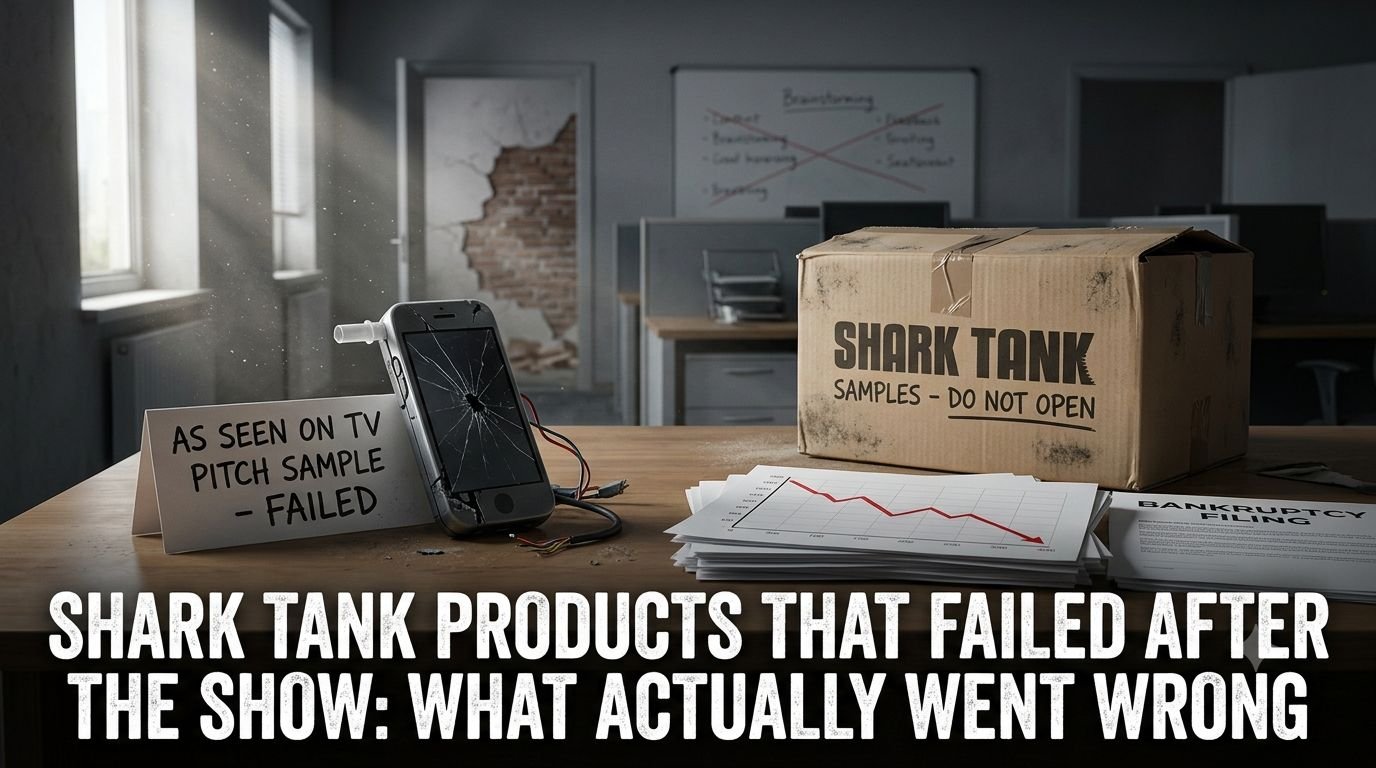
A Shark Tank handshake feels like the finish line. For the founder it is closer to the starting gun, and for some companies the show turned out to be the most expensive thing that ever happened to them.
This article covers three well-documented post-show collapses: ToyGaroo, Sweet Ballz and Breathometer. They failed in three different ways (a logistics trap, a partnership breakdown and a federal enforcement action), and that is exactly why they are worth reading together. After the case studies, we look at the patterns, then at companies that were turned down on the show and did fine anyway.
The Short Answer
Most products that fail after Shark Tank don’t fail because the idea was bad. The three below were each undone by something the TV exposure made worse: demand the business couldn’t fulfil profitably, founders who couldn’t work together, or marketing claims the product couldn’t back up.
Quick Facts: Three Documented Failures
| Company | Aired | What was pitched | Deal on the show | What went wrong |
|---|---|---|---|---|
| ToyGaroo | Season 2 | Toy rental subscription, pitched as “the Netflix of toys” | Mark Cuban reported as the investor; terms differ between sources | Shipping economics, internal disagreement over going on the show, Chapter 7 filing in April 2012 |
| Sweet Ballz | Season 5 premiere, September 2013 | Ready-to-eat cake balls sold in convenience stores | $250,000 for 25% from Mark Cuban and Barbara Corcoran (the founders had asked for 10%) | Co-founder lawsuit filed days after the episode aired; lost web traffic and momentum |
| Breathometer | Season 5, 2013 | Smartphone breathalyzer | $1 million for 30% from all five Sharks (the ask was $250,000 for 10%) | FTC settlement in January 2017 over accuracy claims; refunds ordered |
ToyGaroo: The Idea Was Fine, the Shipping Wasn’t
Nikki Pope walked onto the set in Season 2 with a simple pitch. Parents pay a monthly fee, kids get a rotating box of toys, and nobody has to store a closet full of plastic they’ve outgrown. She called it the Netflix of toys, and the Sharks liked it.
The trouble is that a DVD is flat, light and the same size every time. A toy is none of those things. One account of the company’s problems points to the offer of free shipping on items of wildly different sizes and weights, which meant the cost of every shipment was a surprise. Subscription businesses live or die on predictable cost per customer, and ToyGaroo didn’t have one.
The company’s parent, Hutch Toygaroo, LLC, filed for Chapter 7 bankruptcy on April 6, 2012, roughly a year after it was funded, according to the Shark Tank Blog’s reporting. That blog also notes that Pope was a minority owner of the company she represented on TV, which is worth remembering when you read headlines that treat her as the sole founder.
There’s a revealing quote from Phil Smy, a former executive at the company, in a Failory interview that Looper later cited. He said the team was split into two camps, one that wanted to go on Shark Tank and one that didn’t, and that he was on “team don’t.” That is secondhand through a news outlet, so treat it as one person’s recollection. But it fits a pattern that shows up again below: a company that wasn’t aligned internally before the cameras arrived.
A caution on deal terms: several sites list specific numbers and Sharks for the ToyGaroo deal, and they don’t agree with each other. I could only confirm Mark Cuban as the reported investor, so I have left the rest out rather than repeat figures I can’t verify. The episode itself, and the show’s Beyond the Tank follow-up (listed as episode 203 by the Shark Tank Blog), are the best primary sources.
The lesson: a viral moment is a stress test for your unit economics. If shipping, returns or fulfilment only work at small scale, TV will find that out for you within weeks.
Sweet Ballz: A Winning Deal and a Lawsuit Ten Days Later
James McDonald and Cole Egger opened Season 5 in September 2013 with cake balls: bite-sized, frozen, sold four to a pack, and already stocked in 7-Eleven stores. They asked for $250,000 for 10%. All five Sharks made offers, and the founders took Mark Cuban and Barbara Corcoran’s bid of the same $250,000 for 25%.
The Dallas Morning News reported that, one week after the episode aired, McDonald sued Egger and others in Dallas County court. A later write-up in Looper puts it at ten days. The dispute actually began before the broadcast. According to McDonald’s lawsuit, Egger had made a “non-negotiable” offer to buy out McDonald and a third partner, Matt Landis. When they refused, Egger launched a competing site, CakeBallz.com, on August 2. McDonald’s suit alleged breach of contract and sought a restraining order and an injunction.
The timing is the cruel part. The Sweet Ballz website was reportedly overwhelmed with orders after the episode and went down while the founders scrambled. By the time it came back, the founders were in court and traffic had been split between two competing sites. One follow-up source says the case was dismissed for want of prosecution by July 2014, after which McDonald kept the brand and Egger was out. I found that on a smaller Shark Tank tracking site rather than in court records, so verify it if you plan to rely on it.
It’s also worth being fair here. Several retrospectives, including Looper’s citing of Failory, argue that the lawsuit wasn’t the only cause. The cake pop craze was fading too. Today the brand is reported to be operated by McDonald as a smaller business, and the website still sells product.
I want to be careful about one thing the original outline for this article claimed, that the founders’ capital was “drained by courtroom litigation.” The sources I could find describe lost momentum and lost web traffic. They don’t give legal-fee figures, so I haven’t repeated that claim.
The lesson: investors can fund a company, but they can’t fix a broken partnership. The most useful due diligence on a business is often a frank conversation among the founders, held before the pitch.
Breathometer: The Biggest Deal, and an FTC Settlement
Charles Michael Yim pitched a small breathalyzer that plugged into a phone’s headphone jack. He asked for $250,000 for 10%. He walked away with $1 million for 30% from all five Sharks, a rare outcome that made it one of the most talked-about deals of that season. He had already raised more than $138,000 on Indiegogo against a $25,000 goal, and the Wall Street Journal reported in October 2013 that the company then raised another $2 million.
The company sold two versions, the Original and the Breeze. On January 23, 2017, the Federal Trade Commission announced a settlement with Breathometer, Inc. and Yim. The FTC alleged the company made accuracy claims it couldn’t support, and that it knew the devices frequently under-reported blood alcohol levels. According to the FTC’s complaint, sales of the two products totalled about $5.1 million. Under the settlement the company agreed to offer full refunds, and both the company and Yim were barred from making future accuracy claims for a consumer breathalyzer unless they could back them up.
Two details are worth keeping straight, because secondary sites often blur them. First, the FTC announced a settlement, not a trial verdict. Second, Kevin O’Leary said in response that the company had stopped manufacturing both products in 2015, before the FTC inquiry began. Mark Cuban was later quoted calling it the worst execution in Shark Tank history, blaming the founder’s handling of the money. That characterization is widely repeated, but I could only trace it through secondary summaries, so I’d treat it as Cuban’s opinion rather than an established finding.
Read the FTC’s own announcement here: Breathometer Marketers Settle FTC Charges of Misrepresenting Ability to Accurately Measure Users’ Blood Alcohol Content.
The lesson: if your product’s value depends on a number being right, whether that is blood alcohol, blood pressure or battery life, the accuracy testing has to come before the advertising.
Why These Things Keep Happening
Three causes show up across these stories and across the broader Shark Tank failure lists.
1. The handshake isn’t the deal. The agreement made on camera is a preliminary one. Due diligence comes afterward, and plenty of deals change or fall apart there. You’ll often see the claim that roughly half of on-air deals never close. I couldn’t trace that number to a primary source, and the show doesn’t publish the data, so read it as a rule of thumb. Note too that none of the three companies above lost their deal in diligence. They had deals and still failed, which says something about how much the money matters compared with everything else.
2. Demand arrives before the business is ready. ToyGaroo and Sweet Ballz both saw orders jump. Neither could convert that attention into profitable, stable operations, one because of shipping costs and the other because the founders were in court.
3. Claims outrun the product. Breathometer is the clearest case. Marketing promised precision that regulators said the device didn’t deliver.
What the Survivors Did Differently
It would be easy to read this and conclude Shark Tank is a trap. It isn’t. Some companies were helped enormously by the show, and some that were rejected did well anyway.
- Everyday products with repeat purchases. Companies selling things people reorder tend to absorb the post-show spike better than novelty items. See our breakdown of how Bombas grew after Shark Tank.
- Using the Sharks for operations, not just cash. Investors’ supplier and retail relationships can solve exactly the scaling problems ToyGaroo ran into. Our piece on how Cousins Maine Lobster handled franchising and supply is a good example.
- Rejection isn’t the end. Jamie Siminoff pitched his video doorbell, then called DoorBot, to the Sharks and didn’t get a deal. The company became Ring, and Amazon acquired it in 2018 in a deal widely reported at around $1 billion.
A Quick Checklist for Anyone Heading Into a Pitch
- Can your cost per order stay predictable if volume increases tenfold in a week?
- Do all the founders and shareholders agree in writing on control, equity and what happens in a dispute?
- Can you prove every performance claim in your marketing with independent testing?
- Is there cash to cover the gap between a surge in orders and getting paid?
Conclusion
ToyGaroo, Sweet Ballz and Breathometer don’t prove that Shark Tank is dangerous. They show that television exposure multiplies whatever is already true about a company, strengths and weaknesses alike. A business with sound unit economics, aligned founders and honest marketing gets a boost. One without them gets found out faster.
Frequently Asked Questions
Do most Shark Tank companies fail after the show?
Nobody outside the production publishes reliable numbers, so there is no trustworthy percentage. Many companies grow, many stall, and a few collapse spectacularly. The failures get the headlines.
What was the biggest Shark Tank failure?
There’s no official ranking. ToyGaroo (Chapter 7 within about a year of funding) and Breathometer (an FTC settlement, with the FTC citing $5.1 million in sales) are two of the most commonly cited.
Why do deals fall apart after the cameras stop?
The on-air agreement is preliminary. Financial review, legal review and disagreements about valuation or terms can all change or end a deal.
Can a company succeed after being turned down on Shark Tank?
Yes. Ring, which pitched as DoorBot, is the best-known example.
Is Sweet Ballz still in business?
It appears so. The brand’s website still sells product, and reports describe it as run by co-founder James McDonald as a smaller operation.
How this article was researched: Every claim below comes from a regulator’s own press release (the FTC), contemporaneous local reporting (the Dallas Morning News), or follow-up coverage that names its sources. Where outlets disagree, or where I could not confirm a detail, I say so instead of picking the version that reads best. Shark Tank’s producers don’t publish tracking data on what happens to deals after taping, so anything claiming a precise “failure rate” deserves suspicion, including numbers repeated further down this page.